Safe Child Policy
Sandwich Pantry is the operating name of Sandwich Social Supermarket CIC.
Registered operating address: 67 Strand Street, Sandwich, England, CT13 9HN.
Operating Address: Sandwich Community Hub: The Jubilee Centre, Jubilee Road, Sandwich CT13 0QP.
Email Address: Oursandwichpantry@gmail.com
Telephone No: 07377 808477
Company Registration No: 13052443
Insurance: Greens Insurance, 5 Market Street ,Sandwich CT139DA
Designated Safeguarding Lead (DSL)
Danny Lang : mobile - 07411 530415
: e-mail - danny.lang@btinternet.com
Deputy DSL
David Wood :mobile - 07595 348114
:e-mail dmawood@me.com
The Objects of Sandwich Pantry are:
To carry on activities which benefit the community, and in particular (without limitation) where there are issues of food poverty, isolation and deprivation to provide the local community with ethically sourced and affordable food and a range of other support services.
Operation
Sandwich Pantry operates from the Sandwich Community Hub. Members of the local community can become Sandwich Pantry members and by paying a weekly fee can select a good basket of food. Volunteers work to source the food from Fareshare-East Kent and other local sources. Members attend the Pantry weekly which is run by the Volunteers.
Our work is primarily with individual adult members, but children do attend with parents.
Sandwich Pantry acknowledges that we have a duty to demonstrate compliance in the following key areas.
Ensuring that we have a Safeguarding and Child Protection Policy in place which highlights how to deal with Safeguarding Incidents.
Ensuring this policy is distributed to all volunteers and is publicly available.
Ensuring that all directors and volunteers have an awareness of safeguarding issues and what potential risks could harm children and young people.
Ensuring that our safeguarding policy has clear procedures detailing what to do if a volunteer, or other adult poses a risk of harm to children or if a child or young person makes a disclosure to a volunteer at the community centre.
Ensuring that a Designated Safeguarding Lead undertakes and refreshes their training in line with statutory, NCVO/NSPCC standards.
Ensuring that all volunteers and partner organisations understand that we do not support lone working under any circumstances.
· A copy of any safeguarding action record should be sent to the Secretary of Sandwich Social Supermarket for the attention of the Directors.
· Sandwich Social Supermarket will have a safeguarding agenda item for every directors board meeting and will produce an annual safeguarding report.
· We will obtain DBS clearance & 2 references for new volunteers.
Our Safeguarding and Child Protection Policy
Sandwich Pantry believes that everyone has a responsibility to promote the welfare of all children and young people, to keep them safe and to run the Pantry in a way that protects them from harm. We will give equal priority to keeping all children and young people safe regardless of their age, disability, gender reassignment, race, religion or belief, sex, or sexual orientation. We recognise that some children are additionally vulnerable because of the impact of discrimination, previous experiences, their level of dependency, communication needs or other factors such as SEND, socio-economic circumstance, immigration status and vulnerability to embedded dangers such as county lines and modern-day slavery.
We will meet our commitment to keeping children safe by listening to the children and young people that use the services our centre provides and by treating them with respect. We will ensure that we nominate a child protection lead and have a DSL and Deputy DSL sitting on the CIC board, both of whom will complete the necessary training and take responsibility for safeguarding on behalf of our organisation. We will disseminate our training to all our volunteers.
We will ensure that all the children and young people and families that we work with will know about our organisation’s safeguarding and child protection policies and know what to do if they have a concern. We will prioritise and promote an open, transparent, and inclusive safeguarding culture where volunteers, members and children know how they are expected to behave and feel comfortable about sharing concerns.:
Sandwich Pantry Safeguarding and Child protection policy is informed by the following legislation and guidance:
Kent Safeguarding Support Level Guidance document and procedures. www.kscmp.org.uk
Bond’s Good Governance for Safeguarding, A guide for UK NGO Boards.
https://www.bond.org.uk/resources/good-governance-for-safeguarding-a-guide-for-uk-ngo-boards/
Government Guidance - Working together to Safeguard Children (2023). https://assets.publishing.service.gov.uk/media/65803fe31c0c2a000d18cf40/Working_together_to_safeguard_children_2023_-_statutory_guidance.pdf ( Please refer to page 128 for Voluntary, charity, social enterprise, faith-based and private enterprise .)
Working together to Safeguard Children: Statutory Framework: legislation relevant to safeguarding and promoting the welfare of Children (2023). https://assets.publishing.service.gov.uk/media/65797f1e0467eb000d55f689/Working_together_to_safeguard_children_2023_-_statutory_framework.pdf
Charity Commission: Safeguarding and protecting people for charities and trustees (last updated 1st June 2022) https://www.gov.uk/guidance/safeguarding-duties-for-charity-trustees
Safeguarding and Child Protection: The role of staff and volunteers
What volunteers need to know:
Volunteers at Sandwich Pantry have responsibility for the welfare and safeguarding of young people and children who attend. They are in a position where they could identify concerns early, provide help for children promote children’s welfare and prevent concerns from escalating.
Volunteers at Sandwich Pantry have an equal responsibility to provide a safe environment for the children and young people that use Sandwich Pantry.
Volunteers at Sandwich Pantry must be prepared to identify children who may benefit from early help, this means providing support as soon as a problem emerges at any point in a child’s life from the foundation to teenage years.
Definitions and Signs of Child Abuse
The NSPCC has a online resource which is available through this link: Definitions and signs of child abuse (nspcc.org.uk). It defines child abuse as follows.
"Child abuse happens when a person harms a child. it can be physical, sexual or emotional, but can also involve neglect.”
And notes that:
Children may be abused by:
o family members,
o friends
o people working or volunteering in organisational or community settings
o people they know
o or strangers.
Volunteers should have an awareness of, and the ability to, recognise signs child abuse and neglect as defined above.
They should use this NSPCC online resource to help them to be able to identify a child or young person who needs help and support.
· Volunteers will have an up-to-date knowledge of current safeguarding issues such as: child on child abuse, child sexual exploitation, child criminal exploitation, domestic abuse, Female Genital Mutilation, mental health and serious violence.
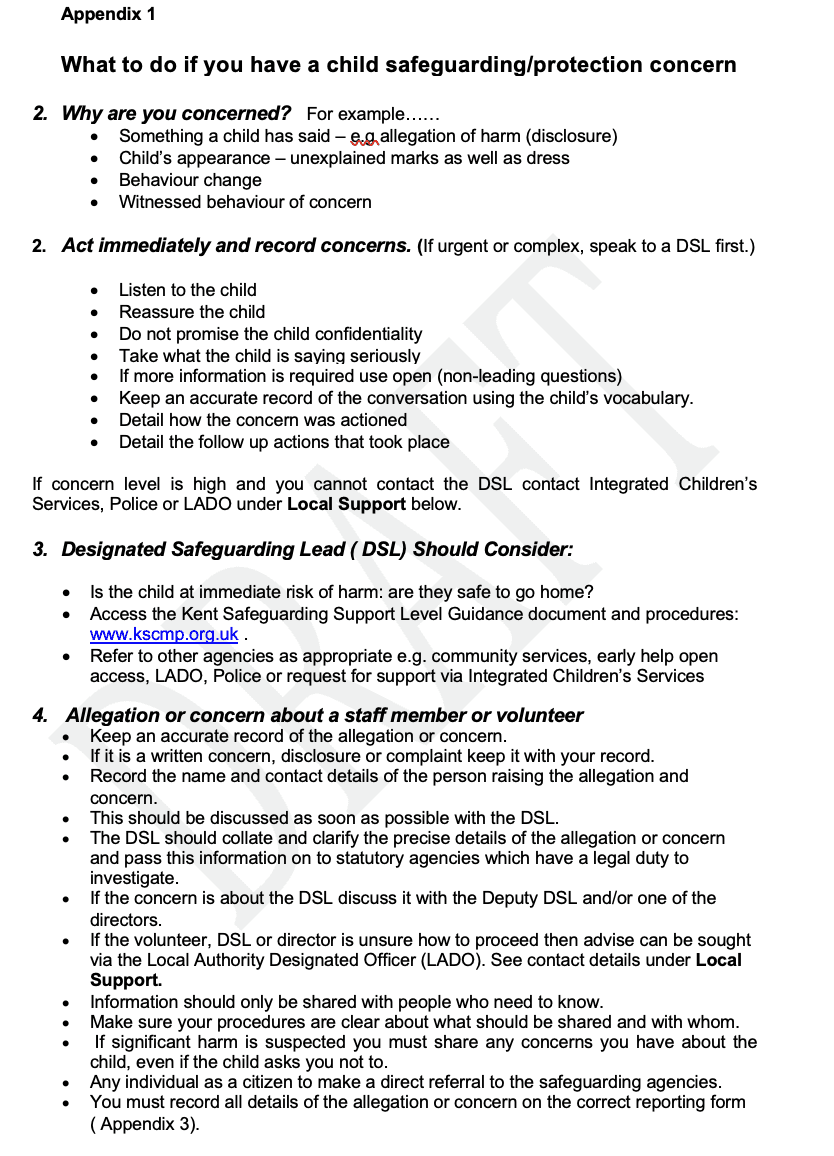
Any staff member or volunteer who has a concern about a child’s welfare has a responsibility to follow the actions set out below on page 4.
What to do if you have a child safeguarding/protection concern
1. Why are you concerned? For example……
· Something a child has said – e.g allegation of harm (disclosure)
· Child’s appearance – unexplained marks as well as dress
· Behaviour change
· Witnessed behaviour of concern
2. Act immediately and record concerns.
*If urgent or complex, speak to a DSL first
· Listen to the child
· Reassure the child
· Do not promise the child confidentiality
· Take what the child is saying seriously
· If more information is required use open (non-leading questions)
· Keep an accurate record of the conversation using the child’s vocabulary.
· Detail how the concern was actioned
· Detail the follow up actions that took place
If concern level is high and you cannot contact the DSL contact Integrated Children’s Services, Police or LADO under Local Support below.
3. Designated Safeguarding Lead ( DSL) Should Consider:
· Is the child at immediate risk of harm: are they safe to go home?
· Access the Kent Safeguarding Support Level Guidance document and procedures: www.kscmp.org.uk .
· Refer to other agencies as appropriate e.g. community services, early help open access, LADO, Police or request for support via Integrated Children’s Services
4. Allegation or concern about a staff member or volunteer
· Keep an accurate record of the allegation or concern.
· If it is a written concern, disclosure or complaint keep it with your record.
· Record the name and contact details of the person raising the allegation and concern.
· This should be discussed as soon as possible with the DSL.
· The DSL should collate and clarify the precise details of the allegation or concern and pass this information on to statutory agencies which have a legal duty to investigate.
· If the concern is about the DSL discuss it with the Deputy DSL and/or one of the directors.
· If the volunteer, DSL or director is unsure how to proceed then advise can be sought via the Local Authority Designated Officer (LADO). See contact details under Local Support.
· Information should only be shared with people who need to know.
· Make sure your procedures are clear about what should be shared and with whom.
· If significant harm is suspected you must share any concerns you have about the child, even if the child asks you not to.
· Any individual as a citizen to make a direct referral to the safeguarding agencies.
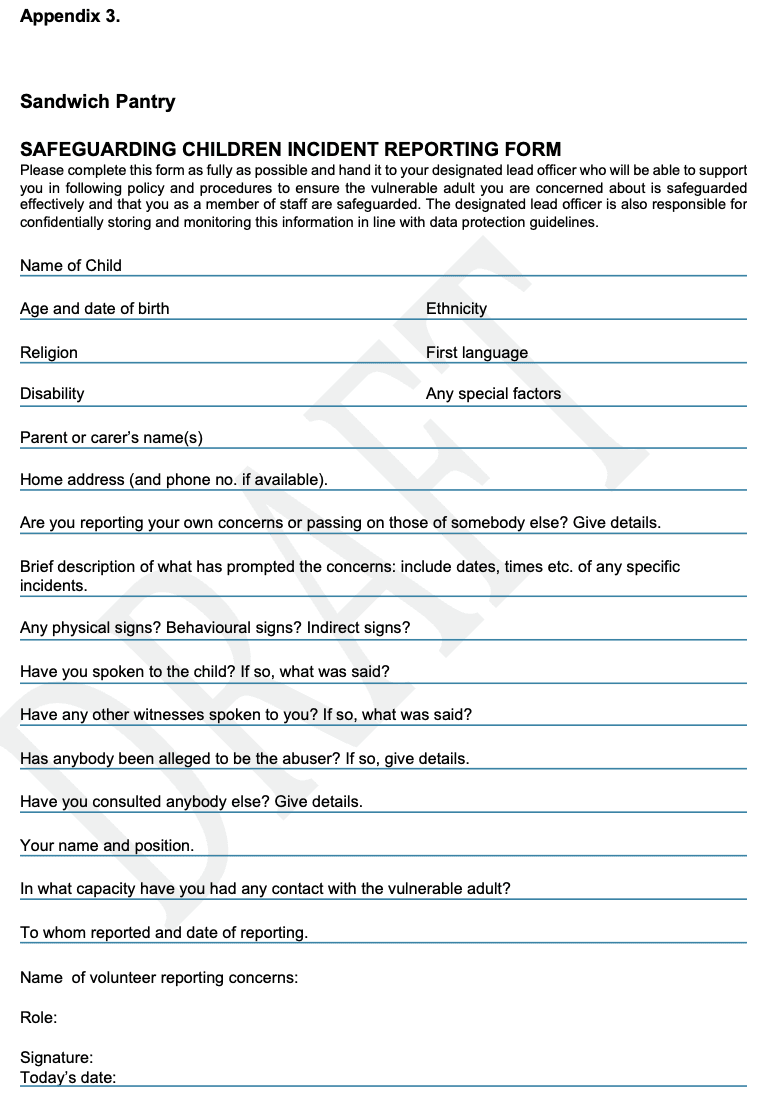
· You must record all details of the allegation or concern on the correct reporting form ( Appendix 3).
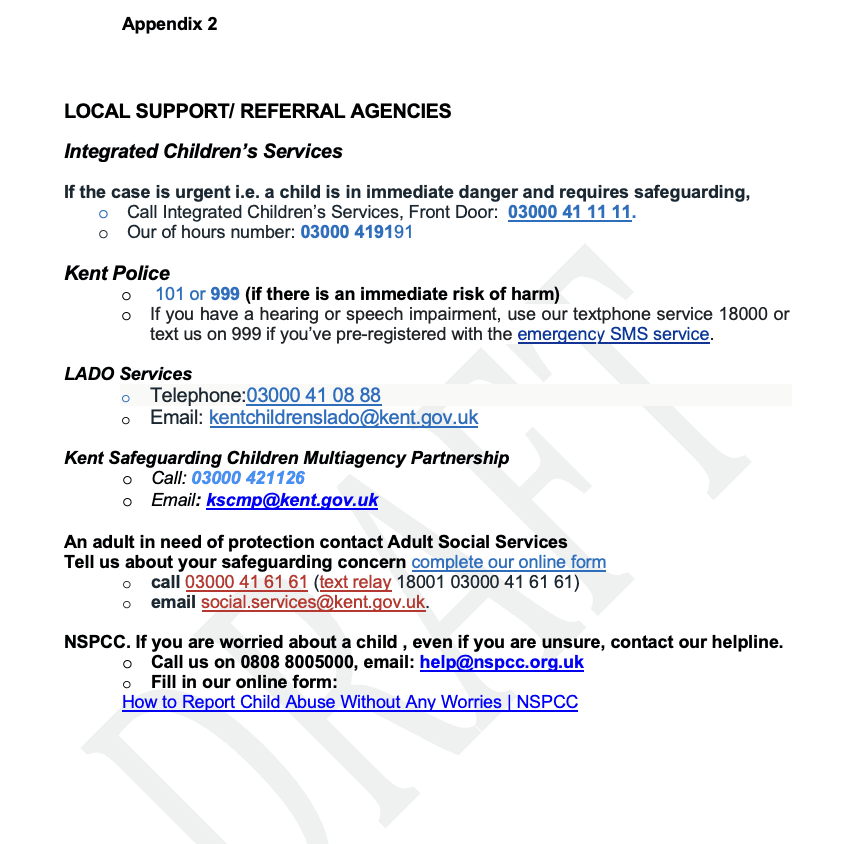
5. LOCAL SUPPORT/ REFERRAL AGENCIES
Integrated Children’s Services
If the case is urgent i.e. a child is in immediate danger and requires safeguarding,
o Call Integrated Children’s Services, Front Door: 03000 41 11 11.
o Our of hours number: 03000 419191
Kent Police
o 101 or 999 (if there is an immediate risk of harm)
o If you have a hearing or speech impairment, use our textphone service 18000 or text us on 999 if you’ve pre-registered with the emergency SMS service.
LADO Services
o Telephone:03000 41 08 88
o Email: kentchildrenslado@kent.gov.uk
Kent Safeguarding Children Multiagency Partnership
o Call: 03000 421126
o Email: kscmp@kent.gov.uk
An adult in need of protection contact Adult Social Services
Tell us about your safeguarding concern complete our online form
o call 03000 41 61 61 (text relay 18001 03000 41 61 61)
o email social.services@kent.gov.uk.
NSPCC. If you are worried about a child , even if you are unsure, contact our helpline.
o Call us on 0808 8005000, email: help@nspcc.org.uk
o Fill in our online form:
How to Report Child Abuse Without Any Worries | NSPCC
These Appendices are extracts from the Policy to be available and displayed in the Sandwich Pantry office.