Safe Adult Policy
Sandwich Pantry is the operating name of Sandwich Social Supermarket CIC
Registered operating address: 67 Strand Street, Sandwich, England, CT13 9HN
Operating Address: Sandwich Community Hub: The Jubilee Centre, Jubilee Road, Sandwich CT13 0QP
Email Address: Oursandwichpantry@gmail.com
Tel No: 07377 808477
Company Registration No: 13052443
Insurance: Greens Insurance, 5 Market St. Sandwich, CT139DA
Designated Person (DP)
Danny Lang
M: 07411 530415
E: danny.lang@btinternet.com
Deputy Designated Person
David Wood
M: 07595 348114
E: dmawood@me.com
INTRODUCTION
Sandwich Pantry is committed to safeguarding and promoting the welfare of vulnerable adults engaged in the breadth of its activities. Staff and directors may receive disclosures of abuse and observe vulnerable adults who are at risk. This policy will enable staff/volunteers to make informed and confident responses to specific adult protection issues.
PURPOSE
The purpose of this policy is to outline the duty and responsibility of staff and volunteers working on behalf of Sandwich Pantry in relation to the protection of vulnerable adults from abuse.
All adults have the right to be safe from harm and should be able to live free from fear of abuse, neglect and exploitation.
“Abuse is a violation of an individual’s human and civil rights by any other person or persons”
(Kent and Medway Safeguarding Vulnerable Adults, 2010)
The key objectives of this policy are:
To explain the responsibilities Sandwich Pantry and its staff, volunteers and trustees have in respect of vulnerable adult protection
To provide all with an overview of vulnerable adult protection
To provide a clear procedure that will be implemented where vulnerable adult protection issues arise.
GUIDING PRINCIPLES
The following principles guide Sandwich Pantry in safeguarding adults.
1. Everyone has the right to live free from abuse and neglect
2. Everyone has the right to be treated as an individual
3. Everyone has the right to be treated with respect and dignity, with a right to privacy
4. Sandwich Pantry believes everyone should have choice and control over their lives, with as much independence as is possible, and will help people maintain confidence and positive self-esteem
5. We will not tolerate any kind of abuse to anyone, not least a vulnerable adult
6. We will make sure our service users are aware of our Safeguarding Adults Policy and Procedure
7. Everyone at Sandwich Pantry has a responsibility to prevent, recognise and act on abuse and neglect
8. We will make sure all and volunteers understand their role in relation to safeguarding adults. We will provide appropriate training and ensure staff are competent in preventing, recognising and acting on abuse and neglect
9. Individuals against whom an allegation has been made have the right to fair and unbiased treatment and to be kept fully informed.
LEGAL FRAMEWORK
This policy is based upon important national Acts, policies, protocols, and guidance. These are:
1. Kent and Medway Multi-Agency Adult Protection Policy, Protocols and Guidance (updated 2022): www.kent.gov.uk and follow links to Adult Protection
2. Human Rights Act 1998, the Mental Capacity Act 2005, and Public Interest Disclosure Act 1998
3. General Data Protection Regulation 2018, Data Protection Act 2018, Freedom of Information Act 2000, Safeguarding Vulnerable Groups Act 2006, Deprivation of Liberty Safeguards, Code of Practice 2008
4. The Mental Capacity Act 2005 and Mental Capacity (Amendment) Act 2019 covering England and Wales, provides a statutory framework for people who lack capacity to make decisions for themselves, or who have capacity and want to make preparations for a time when they may lack capacity in the future. It sets out who can take decisions, in which situations, and how they must go about this.
5. The Human Rights Act 1998 gives legal effect in the UK to the fundamental rights and freedoms contained in the European Convention on Human Rights (ECHR).
6. The Public Interest Disclosure Act 1998 (PIDA) created a framework for whistle blowing across the private,public and voluntary sectors. The Act provides almost every individual in the workplace with protection from victimisation where they raise genuine concerns about malpractice in accordance with the Act’s provisions.
DEFINITION OF VULNERABLE ADULT
1. An Adult (a person aged 18 or over) who 'is or may be in need of community care services by reason of mental or other disability, age or illness; and who is or may be unable to take care of him or herself, or unable to protect him or herself against significant harm or exploitation'. (Definition from 'No Secrets' March 2000 Department of Health)
2. This could include people with learning disabilities, mental health problems, older people and people with a physical disability or impairment. It is important to include people whose condition and subsequent vulnerability fluctuates. It may include an individual who may be vulnerable through their role as a carer in relation to any of the above.
3. It may also include victims of domestic abuse, hate crime and anti-social abuse behavior. The persons’ need for additional support to protect themselves may be increased when complicated by additional factors, such as, physical frailty or chronic illness, sensory impairment, challenging behaviour, drug, or alcohol problems, social or emotional problems, poverty, or homelessness.
4. Many vulnerable adults may not realize that they are being abused. For example, an elderly person, accepting that they are dependent on their family, may feel that they must tolerate losing control of their finances or their physical environment. They may be reluctant to assert themselves for fear of upsetting their carers or making the situation worse.
5. It is important to consider the meaning of 'Significant Harm'. The Law Commission, in its consultation document 'Who Decides,' issued in Dec 1997 suggested that; 'harm' must be taken to include not only ill treatment (including sexual abuse and forms of ill treatment which are not physical), but also 'the impairment of, or an avoidable deterioration in, physical or mental health; and the impairment of physical, intellectual, emotional, social or behavioral development'.
6. For purposes of ensuring consistent and widely understood terminology, these policy and procedures will use the phrase ‘Vulnerable Adults’ to identify those eligible for interventions within the procedures.
TYPES OF ABUSE
Abuse may consist of a single act or repeated acts. It may be physical, verbal or psychological, it may be an act of neglect or an omission to act, or it may occur when a vulnerable person is persuaded to enter into a financial or sexual transaction to which he or she has not consented, or cannot consent.
Abuse can occur within any relationship, and it may result in significant harm to, or exploitation of, the person subjected to it.
The Department of Health in its ‘No Secrets’ 2000 report suggests the following as the main types of abuse:
Physical abuse - including hitting, slapping, pushing, kicking, misuse of medication, restraint, or inappropriate sanctions.
Sexual abuse - including rape and sexual assault or sexual acts to which the vulnerable adult has not consented or could not consent or was pressured into consenting.
Psychological abuse - including emotional abuse, threats of harm or abandonment, deprivation of contact, humiliation, blaming, controlling, intimidation, coercion, harassment, verbal abuse, isolation or withdrawal from services or supportive networks.
Financial or material abuse - including theft, fraud, exploitation, pressure in connection with wills property or inheritance or financial transactions, or the misuse or misappropriation of property, possessions or benefits.
Neglect and acts of omission - including ignoring medical or physical care needs, failure to provide access to appropriate health, social care or educational services, the withholding of the necessities of life, such as medication, adequate nutrition and heating.
Discriminatory abuse - including race, sex, culture, religion, politics, that is based on a person’s disability, age or sexuality and other forms of harassment, slurs or similar treatment, hate crime.
Institutional abuse - Institutional abuse, although not a separate category of abuse in itself, requires specific mention simply to highlight that adults placed in any kind of care home or day care establishment are potentially vulnerable to abuse and exploitation. This can be especially so when care standards and practices fall below an acceptable level as detailed in the contract specification.
Multiple forms of abuse - Multiple forms of abuse may occur in an ongoing relationship or an abusive service setting to one person, or to more than one person at a time, making it important to look beyond single incidents or breaches in standards, to underlying dynamics and patterns of harm.
Any or all of these types of abuse may be perpetrated as the result of deliberate intent and targeting of vulnerable people, negligence or ignorance.
DOMESTIC ABUSE
Home Office definition 2004
‘Any incident of threatening behavior, violence or abuse (psychological, physical, sexual, financial or emotional) between adults who are, or have been intimate partners or family members, regardless of gender or sexuality.’
Women’s Aid definition;
‘Domestic violence is physical, sexual, psychological or financial violence that takes place within an intimate or family-type relationship and that forms a pattern of coercive and controlling behavior. This can also include forced marriage and so-called “honour crimes”. Domestic violence may include a range of abusive behaviours, not all of which are in themselves inherently “violent”.
Most research suggests that domestic violence occurs in all sections of society irrespective of race, culture, nationality, religion, sexuality, disability, age, class, or educational level. Both definitions would therefore also include incidents where extended family members may condone or share in the pattern of abuse e.g. forced marriage, female genital mutilation and crimes rationalized as punishing women for bringing ‘dishonor’ to the family. It is important to recognize that Vulnerable Adults may be the victims of Domestic Abuse themselves or be affected by it occurring within their household. This is likely to have a serious effect on their physical and mental wellbeing.
Where Vulnerable Adults are victims of Domestic Abuse, they may need extra support to plan their future. The violence or threat of violence may continue after a victim has separated from the abuser. It is important to ensure that all the vulnerable people in this situation have appropriate support to enable them to maintain their personal safety.
A separate Domestic Abuse Protocol is in place between Police, Social Services and Health. Incidents reported by the police through the domestic abuse protocols will be addressed under the adult protection processes if it is considered that a vulnerable adult may be at risk of abuse. (See Joint Police, Social Services and Health protocol for dealing with cases of domestic abuse where vulnerable adults are involved)
CHILDREN
It is essential that the needs of any children within an abusive or domestic violence situation where there is a vulnerable adult involved are considered and acted upon. Please contact the Lead for Safeguarding or Senior Manager and/or the local social services Safeguarding Children’s team.
PROCEDURE IN THE EVENT OF A DISCLOSURE
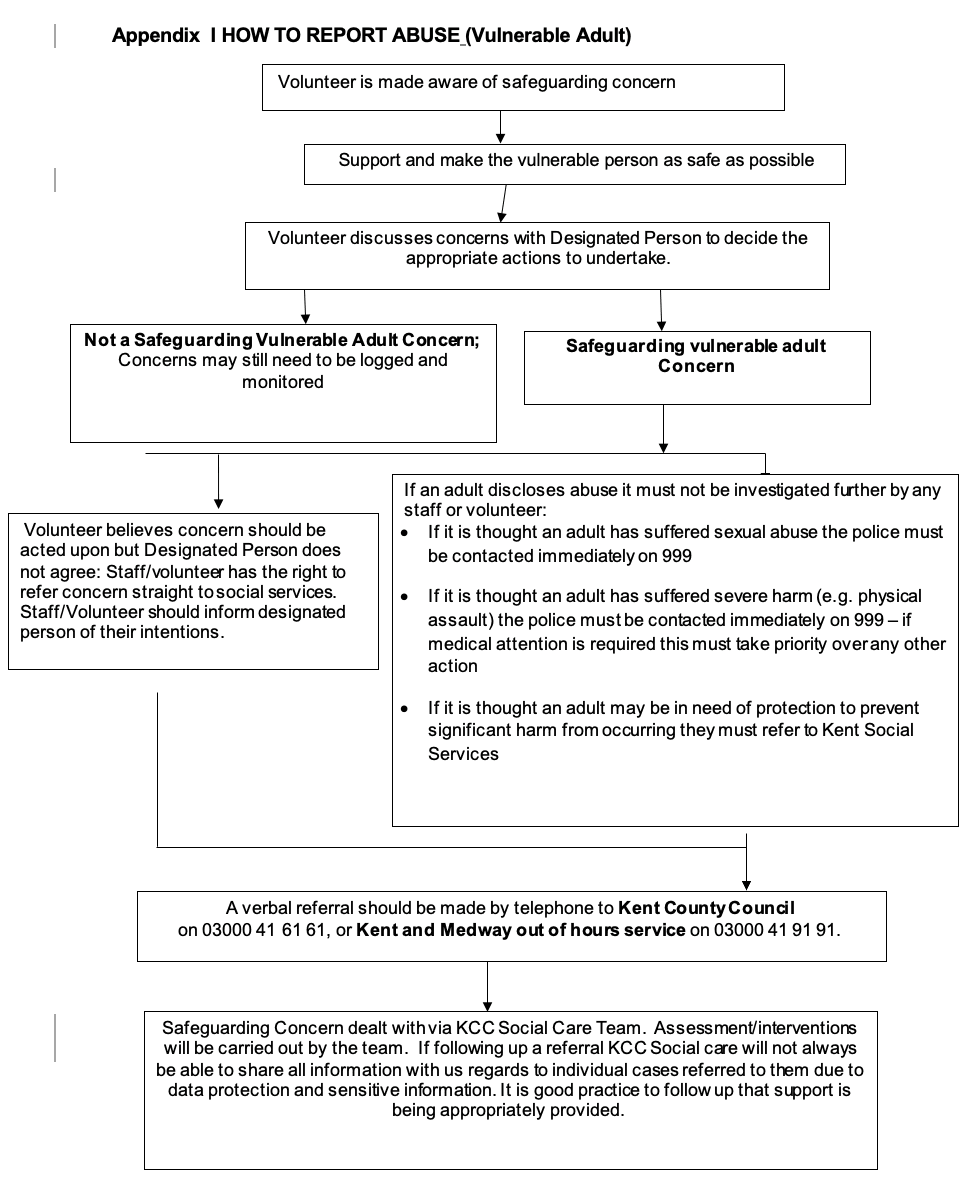
It is important that vulnerable adults are protected from abuse. All complaints, allegations or suspicions must be taken seriously. This procedure must be followed whenever an allegation of abuse is made or when there is a suspicion that a vulnerable adult has been abused:
Promises of confidentiality should not be given as this may conflict with the need to ensure the safety and welfare of the individual.
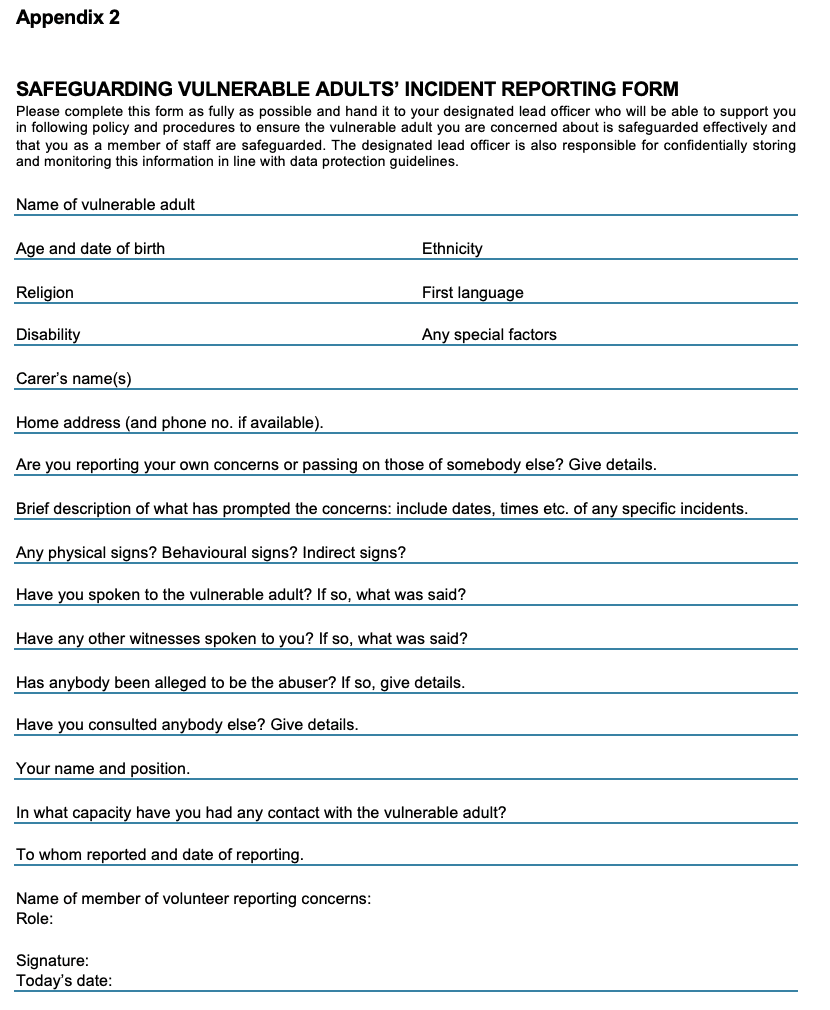
A full record shall be made as soon as possible of the nature of the allegation and any other relevant information. This should include information in relation to the date, the time, the place where the alleged abuse happened, your name and the names of others present, the name of the complainant and, where different, the name of the adult who has allegedly been abused, the nature of the alleged abuse, a description of any injuries observed, the account which has been given of the allegation (See Safeguarding Vulnerable Adults Incident Reporting Form at the back of this policy)
RESPONDING TO AN ALLEGATION
Any suspicion, allegation or incident of abuse must be reported to the designated person immediately. The Designated Person: Danny Lang, Director of Sandwich Pantry
Mob: 07411 530415. Email: danny.lang@btinternet.com. Or the Deputy Designated Person: David Wood 07595 384114. Email: dmawood@me.com
The nominated member of staff shall telephone and report the matter to the appropriate local adult social services duty social worker. A written record of the date and time of the report shall be made, and the report must include the name and position of the person to whom the matter is reported. The telephone report must be confirmed in writing to the relevant local authority adult social services department within 24 hours.
THE ROLE OF KEY INDIVIDUAL AGENCIES
1. Adult Social Services
The Department of Health’s recent ‘No secrets’ guidance document requires that authorities develop a local framework within which all responsible agencies work together to ensure a coherent policy for the protection of vulnerable adults at risk of abuse.
All local authorities have a Safeguarding Adults Board, which oversees multi-agency work aimed at protecting and safeguarding vulnerable adults. It is normal practice for the board to comprise of people from partner organisations who can influence decision making and resource allocation within their organisation.
2. The Police
The Police play a vital role in Safeguarding Adults with cases involving alleged criminal acts. It becomes the responsibility of the police to investigate allegations of crime by preserving and gathering evidence. Where a crime is identified, the police will be the lead agency and they will direct investigations in line with legal and other procedural protocols.
RESPONDING APPROPRIATELY TO AN ALLEGATION OF ABUSE
In the event of an incident or disclosure:
Do
· Make sure the individual is safe
· Assess whether emergency services are required and if needed call them
· Listen
· Offer support and reassurance
· Ascertain and establish the basic facts
· Make careful notes and obtain agreement on them
· Explain areas of confidentiality; immediately speak to your designated person for support and guidance
· Explain the procedure to the individual making the allegation
Don’t
· Confront the alleged abuser
· Be judgmental or voice your own opinion
· Be dismissive of the concern
· Investigate or interview beyond that which is necessary to establish the basic facts
· Consult with persons not directly involved with the situation
· Ask leading questions
· Make promises
· Ignore the allegation
IMPORTANT
It is important to remember that the person who first encounters a case of alleged abuse is not responsible for deciding whether abuse has occurred. This is a task for the professional adult protection agencies, following a referral from the organisation’s designated person.
CONFIDENTIALITY
Vulnerable adult protection raises issues of confidentiality which should be clearly understood by all staff, volunteers and trustees who have a professional responsibility to share relevant information about the protection of vulnerable adults with other professionals, particularly investigative agencies, and adult social services.
Clear boundaries of confidentiality will be communicated to staff, and volunteers.
· All personal information regarding a vulnerable adult will be kept confidential. All written records will be kept in a secure area for a specific time as identified in data protection guidelines. Records will only record details required in the initial contact form.
· If an adult confides in a member of staff and requests that the information is kept secret, it is important that the member of staff tells the adult sensitively that he or she has a responsibility to refer cases of alleged abuse to the appropriate agencies.
· Within that context, the adult should, however, be assured that the matter will be disclosed only to people who need to know about it.
· Where possible, consent should be obtained from the adult before sharing personal information with third parties. In some circumstances obtaining consent may be neither possible nor desirable as the safety and welfare of the vulnerable adult is the priority.
· Where a disclosure has been made, staff should let the adult know the position regarding their role and what action they will have to take as a result.
· Staff should assure the adult that they will keep them informed of any action to be taken and why. The adults’ involvement in the process of sharing information should be fully considered and their wishes and feelings taken into account.
SAFE RECRUITMENT OF STAFF AND VOLUNTEERS
Sandwich Pantry will undertake Disclosure and Barring Service (DBS) checks with volunteers where appropriate. All new volunteers must understand that they could be working with vulnerable people. They must complete an application form and attend and meet with a director to discuss the role. All new staff and volunteers will be required to provide two references personal or professional
We will ensure that all volunteers have appropriate training and will have an induction process, including relevant training. Ongoing training and supervision will ensure allemployees/volunteers are adequately supported.
TRAINING
This organisation recognises the importance of regular learning and development for staff, volunteers and trustees:
The designated person(s) will provide regular appropriate training
All volunteers who come into contact with vulnerable adults will receive ‘Protecting Vulnerable Adults’ training
All volunteers will be fully briefed concerning their safeguarding responsibilities during induction and prior to starting their duties.
MONITORING
Information about safeguarding cases and how they were dealt with will be reported to the Board of Directors regularly. Areas of focus include:
· How quickly the concern was reported to the Designated Person or Director
· How quickly an alert was made to the police/social services
· The quality of information recorded internally
· The quality of input into safeguarding process (feedback from police/social services team)
· Any outcomes of safeguarding process
· Whether any incidents highlighted training issues or a need to amend in-house procedures